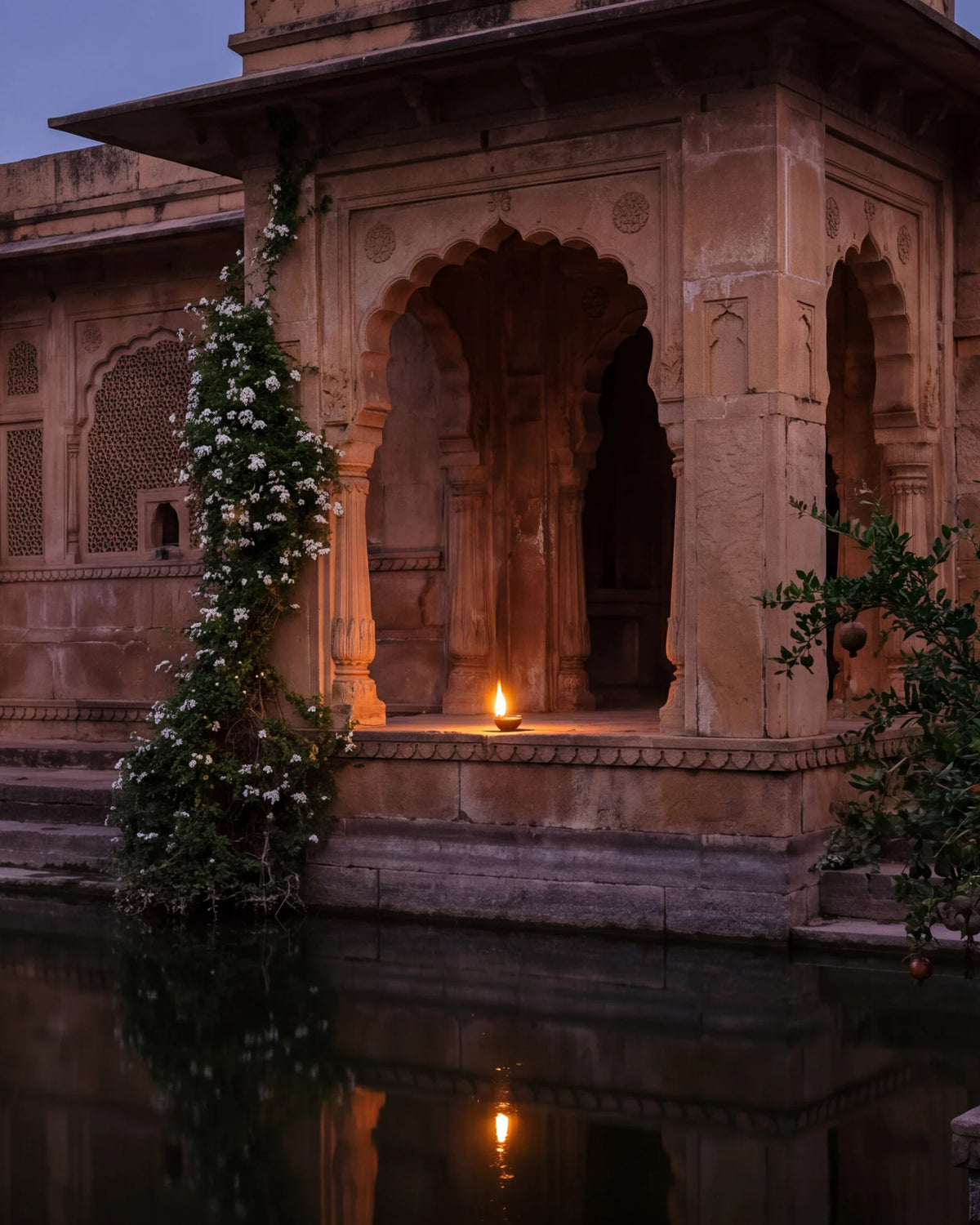

On the far bank of the Yamuna, opposite the Taj Mahal in Agra, lies a garden that was never meant to be looked at by day.

Have You Been Told About India?
The garden grown to bloom after dark

In the 1520s, the first Mughal emperor, Babur, laid out the first of what became a chain of gardens along the river’s edge, eleven in all. He was homesick for the melon groves and running water of his native Ferghana, in Central Asia, and never quite reconciled to the heat and dust he found in its place. The last garden in the chain, nearest the river’s bend, was filled with fruit trees and pale flowers and left largely unnamed. It would take another century, and an entirely different kind of longing, to give it one.
A hundred years later, Shah Jahan built a tomb for his wife, Mumtaz Mahal, on the opposite bank, and folded that older garden into the plan, matching its width exactly to the mausoleum’s own. He filled it with white blossom chosen to open and release its scent at night, and walkways of pale plaster that held the last of the day’s light. At its centre sat an octagonal pool, built purely to hold a reflection. Pale petals, it turns out, carry scent furthest after dark: they show brightest in low light, and their fragrance travels on the cooling evening air. The garden was timed to bloom precisely when there was least light to see it by, scent standing in for sight, and it earned a name that has never needed changing since: Mehtab Bagh, the moonlight garden. On a clear night, the Taj Mahal doubled itself in the water below it.

Agra tells an even grander version of the story. A French traveller passing through later that century recorded a tale that never quite left: that the emperor intended a second tomb on the far bank, an exact twin to the Taj, built entirely in black marble and joined to the white one by a bridge, so that he might lie across the water from her in death as he had loved her in life. No trace of it has ever been found, and historians treat it as legend rather than plan. It is a legend that fits the man it describes rather too well to leave out.
What happened to Shah Jahan afterwards needs no embellishing. His son Aurangzeb deposed him and held him, for his last years, not in the garden he had built to look at his wife’s tomb but in a small marble tower inside Agra Fort, a mile and a half upriver, its latticed windows angled so they could show him nothing else. From there, an old man who had once planted an entire garden simply to be near her memory by moonlight was left to watch that same memory from a captive’s distance for the rest of his life, and, by most accounts, was still watching when he died.
The garden survived him regardless. It flooded and silted over, disappearing beneath the riverbank for the best part of a century, until archaeologists cleared ninety thousand cubic metres of earth from it in the 1990s and found the old pool still holding its shape underneath. It flowers now much as it always did: after dark, for no one in particular, exactly on time.