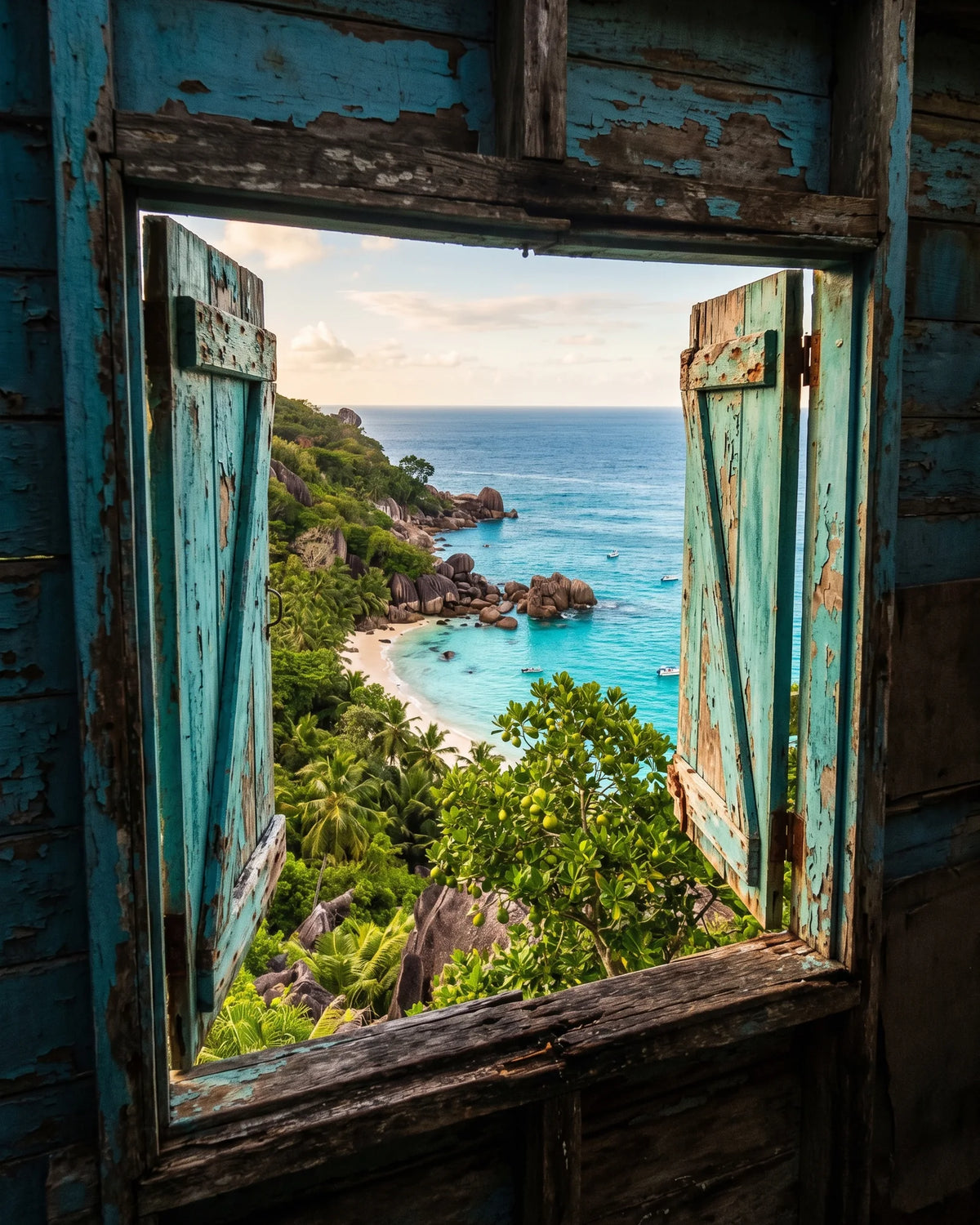

The largest seed in the plant kingdom grows wild in one small valley on one small island, and for centuries nobody could say where it came from at all.

Have You Been Told About the Seychelles?
The seed that came from nowhere

The coco de mer grows in the Vallée de Mai on Praslin and almost nowhere else on earth. Everything about the tree is built on a scale that feels faintly improbable: a nut that can weigh as much as a small child, six years or more to ripen, palms that grow as strictly male or strictly female, and a male flower shaped like a slender catkin the length of a forearm. It is, by any measure, an extravagant plant, entirely unconcerned with modesty. The seed itself, once husked, has an unmistakable shape: two full curves meeting at a deep cleft, closer to the body of a woman than to any coconut. The Seychellois have never pretended otherwise, and the tree’s own French name, which translates simply as coconut of the sea, hints at how far the mystery once travelled before anyone found where it grew.
For a long time, nobody had. Fresh nuts sink, so the only ones the wider world ever saw were old and hollow, washed up an ocean away on the beaches of the Maldives and India with the kernel long gone. Sailors decided, not unreasonably by the logic of the age, that somewhere beneath the sea grew a tree nobody had lived to find, and the name stuck long after the reasoning behind it hadn’t. What washed ashore became treasure. Kings believed the shell could draw poison from wine. The Holy Roman Emperor Rudolf II is said to have offered a fortune for a single one, sourced from a tree that, as far as anyone could tell him, might not exist on land at all.

The mystery held until 1768, when the palms were finally found growing on Praslin, and even then the story kept twisting. In 1881 the British general Charles Gordon walked into the Vallée de Mai, studied the evidence in front of him, and concluded, with total sincerity, that he had located the Garden of Eden, the coco de mer being, in his reading, self-evidently the forbidden fruit. Looking at the seed, his logic is not difficult to follow, even where history has been kinder to the palm than to the general’s theology.
The islands keep their own version, older and gentler than any European’s. On stormy nights, it’s said, the male palms uproot themselves and cross the valley to embrace the females, and anyone who witnesses it is struck blind, or worse. No one has ever come forward to contradict the story, for the simplest reason there could be: no witness has ever come forward at all.
Every nut today is numbered and licensed by the state, and people still try to take them anyway. Four centuries on, nobody has managed to convince the world it’s only a seed.